
- Client
- INCM (Imprensa Nacional–Casa da Moeda), for SNIAC, Cabo Verde's National Civil Identification and Authentication System
- Sector
- Public administration · Digital identity
- Scope
- Full development of the national eID middleware, delivered end to end by Caixa Mágica
- Documents supported
- National Identity Card (CNI) and Residence Permit for Foreigners (TRE)
- Reach
- Every Cabo Verdean citizen and foreign resident. Supports all formal digital signature and authentication processes in the country
- Architecture
- Modular, cross-platform, built on open source components
- SDK
- Available in multiple programming languages for third-party integration
- Award
- Prémio Abertura 2021, ESOP. First international nomination in the award's history
- Status
- In production. Distributed by SNIAC at sniac.cv
Caixa Mágica Software developed, in its entirety, the Cabo Verde eID middleware. It's a cross-platform software solution designed to let every Cabo Verdean citizen make the most of their National Identity Card (CNI) across digital contexts. The project forms part of a wider strategy for administrative modernisation and digital transformation in Cabo Verde. As a result, public services have progressively moved closer to citizens, simplifying procedures that once required a physical presence at counters and government offices. Later, support was extended to a second official document: the Residence Permit for Foreigners (TRE), with functionalities largely similar to those of the CNI.
As with the Portuguese Citizen Card middleware, Caixa Mágica was called upon to design a robust solution for Cabo Verde. The company drew closely on more than a decade of experience developing digital identity systems. The result was cross-platform software, compatible with the leading operating systems on the market. It bridges the user's computer and the chip on the CNI, giving the operating system, browsers and other applications a broad set of authentication, digital signing and document management functionalities.
Challenge
Cabo Verde is an archipelago of ten islands scattered across the Atlantic Ocean. Because of this, it faces connectivity and public-service access challenges that are largely distinct from those seen in continental territories. The geographic dispersion of the population is compounded by a large diaspora spread across Europe and the rest of the world. As a result, digitising state services isn't just about modernisation — it's about equity and inclusion. A citizen living on a remote island, or abroad, must be able to authenticate, sign documents and manage their identity document without travelling to a physical service counter.
That was the challenge put to Caixa Mágica: design a middleware that could replicate the reliability already proven in Portugal, while adapting it to Cabo Verde's own legal, institutional and technological specifics. The project was developed in close coordination with two bodies: SNIAC, Cabo Verde's National Civil Authentication System, and INCM, the National Press–Mint. SNIAC defined the functional and legal requirements the middleware had to meet, ensuring full compliance with Cabo Verde's regulatory framework for civil authentication. INCM, in turn, ensured technical compatibility between the physical document and the software — a critical piece for the whole system to work correctly.
A Cross-Border Institutional Effort
This joint effort between Portugal and Cabo Verde is held up today as an example of successful cooperation in open source software. In 2021, it was recognised with the Abertura Award, given by ESOP — the Portuguese Association of Open Source Software Companies. The model brings together a Portuguese company specialising in open source software and digital identity with Cabo Verdean public institutions. As a result, it has become a benchmark for international cooperation in digital public administration. It shows that open, robust and scalable digital identity solutions can be adapted successfully to different national realities, always keeping the citizen at the centre of the process.
Solution
In designing the Cabo Verde eID middleware, Caixa Mágica drew on much of the technical experience built up developing the Portuguese Citizen Card middleware. The architecture was then adapted to the specifics of the new identity document and to Cabo Verde's legal framework. Like the Portuguese solution, the Cabo Verdean middleware follows a modular architecture and is built on open source technologies widely tested by the international development community. This ensures transparency in how it works and makes ongoing maintenance easier. It also reflects Caixa Mágica's broader commitment to open source, which has guided its main digital identity projects in recent years.
Development follows agile methodologies, with regular update cycles. These keep pace with the technological evolution of the operating systems and browsers the middleware interoperates with. They also respond to needs identified by users and by the Cabo Verdean public bodies overseeing the project. Development happens incrementally, with continuous testing across different hardware and software configurations. This ensures compatibility with the wide range of computers and card readers used by citizens and public bodies alike. That care matters even more in an island context, where specialist technical support isn't always immediately available. Reliability and ease of use are therefore a core requirement of the project.
Cabo Verde's eID middleware gives citizens a broad set of functionalities, all accessible through a simple, intuitive graphical interface designed for users with different levels of familiarity with technology. Each of these functionalities responds to a concrete need identified with citizens and Cabo Verdean bodies throughout the product's design process.
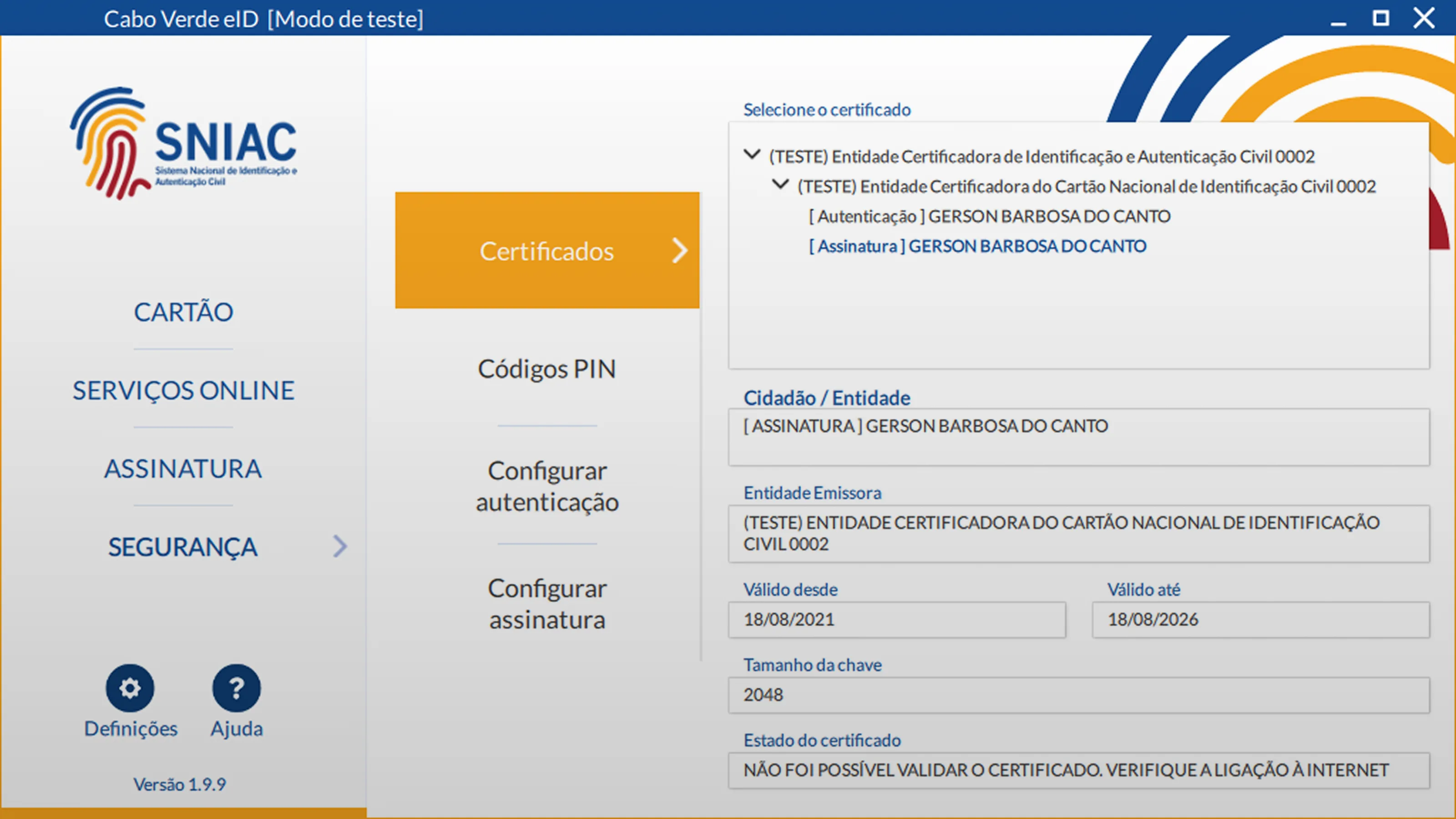
The middleware bridges the CNI's chip with the citizen's computer, browsers and applications.
Key functionalities of the Cabo Verde eID middleware include:
Signing and Authentication
The electronic signature functionality is probably the most significant from the standpoint of the country's digital transformation. Through the middleware, any citizen can digitally sign contracts, declarations, applications and other documents using the CNI, the TRE, or the Mobile Digital Key. These signatures carry the same legal standing as a handwritten one, without needing to print, sign on paper and scan the document again. The middleware also lets citizens customise how the signature appears on the final document. For example, it's possible to include or omit the signing date, choose the position of the signature seal, or adjust how much detail is shown about the signatory — always within the legal requirements for qualified electronic signatures.
The population is spread across nine inhabited islands, and Cabo Verde also has a large diaspora across Europe and the rest of the world. Because of this, a remote activation feature for the digital certificates became necessary. It lets a citizen receive their card at home and then gain access to the eID functions, avoiding a trip to a State service point. A secure activation system with server-side components was developed for this purpose. First, the citizen verifies their identity with State services by phone or video call and obtains the full signature PUK. Next, they use that PUK to unlock the signature PIN in the middleware's graphical application. Finally, they authenticate with the certificate activation service, which communicates with the CNI's PKI to activate the signature certificate. None of these steps requires a physical visit to a service point.
Identity and Access Management
Each card has different PIN codes, protecting authentication and electronic signing respectively. The middleware provides a dedicated interface allowing the citizen to change either of these codes whenever they consider it necessary — whether as a security precaution or because they've forgotten a previously set code, provided they have the PUK code required to unlock it. It's also possible to check, at any time, the status of the digital certificates linked to the card: their validity, the certifying authority responsible for issuing them, and their trust chain. This functionality matters because it helps ensure that signatures and authentications carried out with the card retain full legal validity over time.
A less common functionality in solutions of this kind, but one that has been gaining particular prominence among users, is the ability to attach informational personal notes to the card. These notes aren't legally binding, but they can be of great practical use in emergency situations. For example, citizens can record emergency contacts, their blood type, or relevant allergies that healthcare professionals should take into account. This information is stored locally, under the cardholder's full control. It can make a real difference in critical moments, particularly when the citizen isn't in a condition to communicate this information verbally.
Data, Privacy and Administration
Security is, by its very nature, one of the fundamental pillars of any digital identity solution, and the Cabo Verde eID middleware is no exception. All operations carried out through the software — from simple authentication to signing documents of high legal value — are processed in encrypted form, following internationally recognised security protocols. This means citizens' data is never exposed to third parties during the process. By design, the most sensitive personal data, such as health-related notes or emergency contacts, stays exclusively on the card's chip, under the cardholder's direct control, rather than on central servers. This significantly reinforces citizens' privacy. The approach is aligned with international best practices in personal data protection, and it reflects Caixa Mágica's ongoing concern with balancing convenience against a strict respect for users' privacy.
Beyond civil identification data, the card provides a private data block, editable and viewable by the cardholder themself. It also holds a second block reserved for specific applications of Cabo Verde's public administration, which can write its own service-related data to it. This separation between civil data, private data, and data from specific State applications lets the card serve multiple purposes without compromising the organisation or clarity of the information it holds.
Finally, the middleware also lets citizens view, in an organised and clear way, all the personal data held on their CNI or TRE — from civil identification data to tax and social security data, where applicable. They can also print or export that data as a PDF whenever needed for administrative purposes, avoiding trips to public services just to obtain a copy or confirmation of certain information.
Impact
The impact of the Cabo Verde eID middleware extends well beyond the simple digitisation of administrative processes. For the ordinary citizen, it means a significant reduction in the time and effort needed to handle matters that, until a few years ago, required an in-person visit to a public service — often involving long queues and limited opening hours. For Cabo Verdeans in the diaspora, remote activation removes a barrier that would otherwise be almost impossible to overcome. Without it, unlocking the functions of their own identity document would mean physically returning to the country.
For the Cabo Verdean State, widespread adoption of this middleware is a meaningful step in modernising the relationship between public administration and citizens. It also aligns the country with international good practice in digital governance. For example, the ability to digitally sign legally valid documents directly simplifies administrative and commercial processes. In turn, this reduces operational costs for citizens and for the public and private entities that interact with them.
From an economic standpoint, digitising these processes also reduces dependence on paper and traditional administrative circuits. The environmental and efficiency gains might seem marginal case by case. However, they become substantial once multiplied across Cabo Verde's entire population.
Some notable outcomes of the Cabo Verde eID middleware:
Citizens on any of the archipelago's ten islands — and in the diaspora — can authenticate, sign documents and manage their official document without visiting a service counter, significantly reducing the time and effort involved in processes that previously required a physical presence.
Extending the middleware to the Residence Permit for Foreigners ensures that equity of access doesn't depend on the nationality of whoever needs the service, extending the benefits of digitisation to all legal residents of the country, not just national citizens.
The ability to digitally sign legally valid documents simplifies administrative and commercial processes, reducing operational costs for citizens and for public and private entities alike, and removing steps that were previously mandatory, such as printing, handwritten signing and repeated scanning of documents.
Reduced dependence on paper and traditional administrative circuits generates environmental and efficiency gains that, while they might seem marginal case by case, become substantial at the scale of Cabo Verde's entire population.
Caixa Mágica Software, working with SNIAC and INCM, built an innovative solution that overcame significant challenges posed by Cabo Verde's geography and population dispersion. The Cabo Verde eID middleware didn't just meet the country's technological and functional needs. It also set a standard for public-private collaboration and the effective use of open source, promoting transparency throughout. This cooperation model brings together a Portuguese company specialising in open source software and digital identity with Cabo Verdean public institutions. As a result, it has become a benchmark for international cooperation in digital public administration. The formal recognition of this joint effort, through the Abertura Award 2021 given by ESOP, underscores the value of the project — not only technical, but symbolic as well.
Speaking at the Prémio Abertura 2021 ceremony, the President of SNIAC thanked INCM for the partnership and Caixa Mágica for developing the solution.
Looking Ahead
Caixa Mágica's work on the Cabo Verde eID middleware doesn't end with the functionalities currently available. The Portuguese Citizen Card middleware, for instance, has incorporated new capabilities over the years, such as reading electronic travel documents compliant with ICAO's Doc 9303 specification. It's therefore natural to expect the Cabo Verdean middleware to keep evolving, too. New functionalities will likely be added progressively, as the needs of citizens and Cabo Verdean public bodies justify.
Maintaining a close dialogue between Caixa Mágica, SNIAC and INCM therefore remains central going forward. It ensures the middleware keeps pace with global technological change, but also with the specific priorities of Cabo Verde's digitisation strategy. In doing so, it cements this project's role as one of the most successful examples of Portuguese–Cabo Verdean cooperation in open source software and digital identity.
Frequently Asked Questions
What is the Cabo Verde eID middleware?
It's a cross-platform software solution, developed in its entirety by Caixa Mágica Software, that connects the chip on Cabo Verde's National Identity Card (CNI) to the citizen's computer, operating system and browsers — enabling authentication, digital signing and identity document management.
Does the middleware work without a stable internet connection?
Yes. Authentication, electronic signing and personal data management are processed locally, directly between the card's chip and the citizen's own computer, so the system does not depend on a constant, high-quality connection to a remote server — a deliberate choice given Cabo Verde's dispersed island geography.
Can Cabo Verdeans living abroad activate their card remotely?
Through a secure remote activation system, a citizen verifies their identity with State services by phone or video call, unlocks their PIN in the middleware application, and activates their certificate — all without ever visiting a physical service point.
Does the middleware support the Residence Permit for Foreigners (TRE)?
Yes. Support was extended to the TRE, Cabo Verde's Residence Permit for Foreigners, with functionalities largely similar to those available for the CNI, ensuring foreign residents have the same access to digital signing and authentication as national citizens.
More About the Cabo Verde eID Middleware
Is Cabo Verde's eID middleware open source?
Yes. The solution follows a modular architecture built on open source technologies widely tested by the international software development community, which supports transparency and makes ongoing maintenance and evolution easier.
Who developed the middleware and with which institutions?
Caixa Mágica Software developed the middleware in close coordination with SNIAC, Cabo Verde's National Civil Authentication System, and INCM, the National Press–Mint — responsible respectively for the legal authentication framework and for producing the official documents.
Has the project received any recognition?
Yes. The cooperation between Portugal and Cabo Verde on this project was recognised with the Abertura Award 2021, given by ESOP, the Portuguese Association of Open Source Software Companies.