- Client
- B2E, Blue Bioeconomy CoLAB, based in Leça da Palmeira
- Sector
- Blue economy · Circular economy · Sustainability
- Scope
- Knowledge aggregation, marketplace, recommendations and AI assistant, designed and built by Caixa Mágica
- AI
- Recommender system using collaborative filtering, plus a retrieval-augmented generation (RAG) assistant
- Data residency
- AI services running within the European Union
- Content
- 100k+ articles · 12k+ patents · 160 projects · 433 funding lines and tenders
- Entities
- 910 entities mapped in the platform directory
- Funding
- An initiative supported by Portugal's Recovery and Resilience Plan (PRR), through the Blue Bioeconomy mobilising agenda
- Status
- Live since 2025 at fishmatter.b2e.pt
Caixa Mágica designed and built Fish Matter, the digital platform through which Blue Bioeconomy CoLAB (B2E) turns what the fishing industry once threw away into new economic value. Every year the sector generates enormous volumes of by-products, among them heads, viscera, skins and shells, rich in compounds prized by the food, cosmetics, nutraceutical, biomedical and chemical industries. Fish Matter connects the organisations that generate these materials with the technologies and partners that can transform them, wrapping the whole exchange in aggregated knowledge, an intelligent marketplace and an EU-based AI assistant.
The result is a single meeting point for Portugal's blue bioeconomy: a place to learn, to discover opportunities and to find the right partner. It was built by Caixa Mágica on more than two decades of experience in data platforms, recommendation systems and applied artificial intelligence.
On the platform today: 910 entities · 100k+ articles · 12k+ patents · 160 projects · 433 funding lines and tenders · AI with RAG and EU data residency. Aggregated content and current platform capabilities.
Challenge
The blue bioeconomy is one of the most promising frontiers of the circular economy. Even so, it is held back by a stubborn problem: fragmentation. The knowledge needed to valorise a by-product is scattered across scientific papers, project reports, patent databases, funding calls and public tenders. The organisations that generate marine by-products rarely know which technologies could transform them. The research groups and companies holding those technologies rarely know where the raw material is. Opportunities are lost not for lack of value, but for lack of connection.
That gap carries real costs. A by-product has a short window of use: if nobody claims it in time, it goes to final disposal and its value disappears with it. On the other side, a team that has spent years developing an extraction process needs a predictable flow of raw material to test it at industrial scale. Without a common place where supply, demand and knowledge meet, both sides end up waiting for each other.
The Core Problem
A high-potential sector was underperforming because its knowledge, its supply and its demand lived in separate silos. Valuable by-products were treated as waste simply because the people who could use them and the people who produced them never met.
What the platform had to achieve
B2E set out to build the connective tissue the sector lacked. The platform had to do three things at once. It had to become the definitive knowledge hub for the blue bioeconomy, gathering dispersed information into one trustworthy place. It had to provide a marketplace where by-products, technologies and services could actually be offered and found. And it had to be genuinely intelligent, guiding each user to the partners, opportunities and content most relevant to them, rather than leaving them to search an ever-growing catalogue unaided.
Because the platform would serve companies, research institutions and public bodies handling commercially and scientifically sensitive information, it also had to be trustworthy in how it handled data, including the data flowing through its AI features. European data residency was a design principle from the outset, not an afterthought.
Solution
Caixa Mágica delivered Fish Matter as an integrated platform built around three pillars: a knowledge layer that aggregates the sector's dispersed information, a marketplace with intelligent recommendations that connects supply and demand, and an EU-based AI assistant that makes the whole knowledge base conversational. The platform is promoted and operated by B2E within an initiative supported by Portugal's Recovery and Resilience Plan (PRR).
The three pillars were designed to feed one another. Aggregated knowledge gives the marketplace its context, the marketplace generates interaction signals that sharpen the recommendations, and the assistant opens all of that material to users who do not yet know where to start looking. Each feature answers a specific need identified with B2E and with sector players during the design of the product.
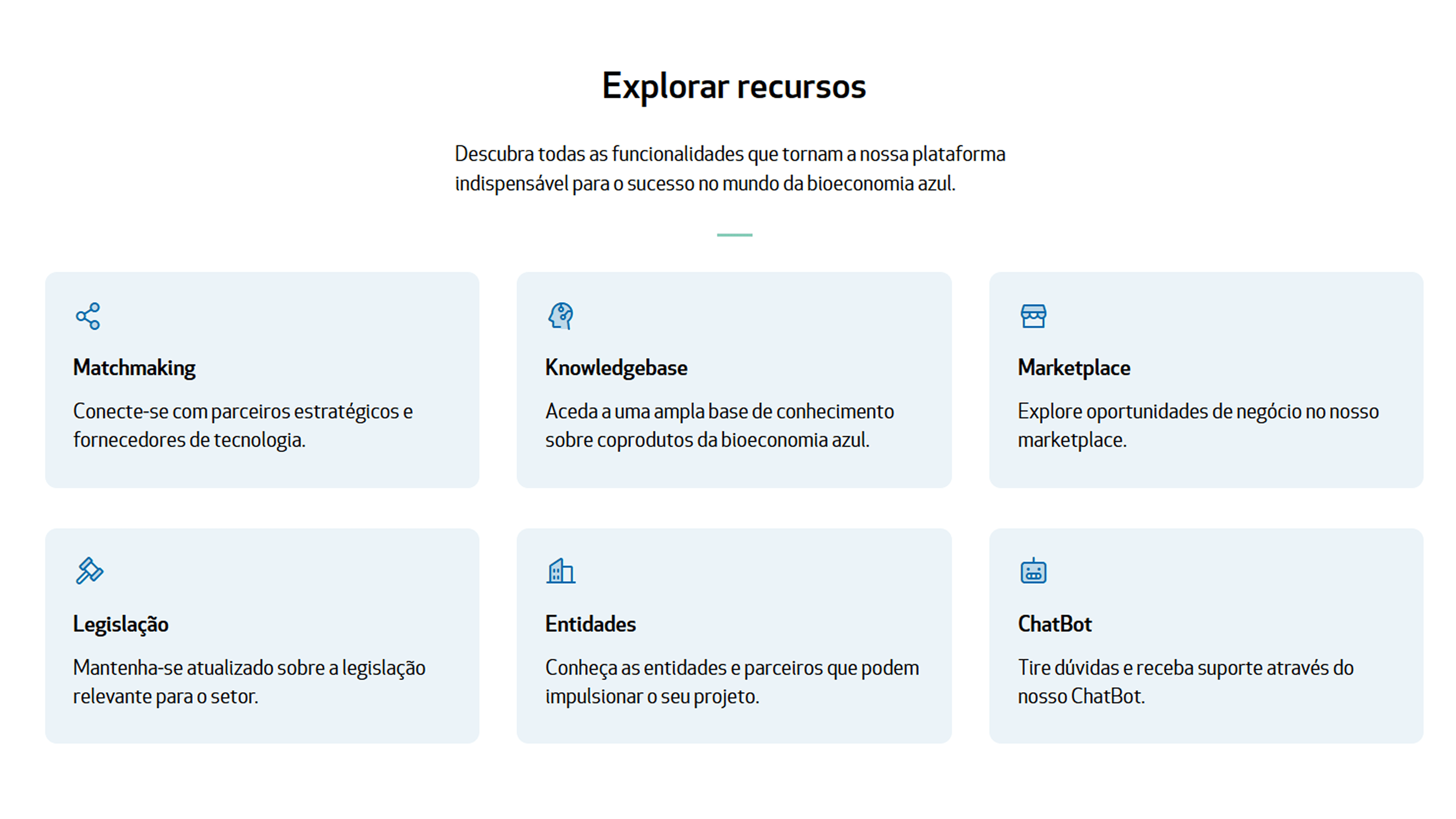
The platform's six areas: matchmaking, knowledge base, marketplace, legislation, entities and chatbot.
Key components of the Fish Matter platform:
Aggregated Knowledge for the Whole Sector
At its foundation, Fish Matter aggregates the information the sector needs but could never find in one place: scientific and technical articles, research and innovation projects, patents, funding lines and open tenders. A user no longer has to monitor a dozen sources to keep up with the blue bioeconomy. The platform brings the field together and keeps it current.
Around this core, the platform maps the ecosystem itself. A directory of entities lets organisations discover and profile potential partners, while a dedicated legislation area keeps users informed of the regulatory framework that governs the valorisation of marine by-products. Knowing who does what, and what the rules are, becomes part of the same experience.
An Intelligent Marketplace
The marketplace is where knowledge becomes business. Organisations can offer and find marine by-products, valorisation technologies and specialist services, transforming material that was once discarded into a tradable resource. It gives the circular economy of the sector a concrete, operational home.
What makes the marketplace more than a listing board is the intelligence layer above it. A recommendation system, drawing on techniques such as collaborative filtering, learns from how users interact with the platform to suggest the most relevant partners, opportunities and content to each one. Instead of searching blindly, a by-product generator is pointed towards the transformers and technologies best matched to its materials, and vice versa. This is matchmaking across the value chain, automated and continuously improving. Match recommendations are generated live for each profile, complemented by manual matchmaking when a specific case calls for it.
An EU-Based AI Assistant
To make the platform's depth immediately accessible, Fish Matter includes an AI assistant. Rather than answering from a generic model's memory, the assistant uses retrieval-augmented generation (RAG) over Fish Matter's own knowledge base, so its responses are grounded in the curated articles, projects, patents and regulatory content the platform holds. A user can simply ask a question in natural language and receive an answer rooted in the sector's real information, with the sources behind it.
The assistant was designed with data protection and digital sovereignty in mind. Its AI services run within the European Union, so the processing of the sector's data stays aligned with European privacy principles. That is an important assurance for the companies, research institutions and public bodies that rely on the platform.
Impact
Fish Matter changes the economics of what the fishing industry once discarded. By making knowledge findable, supply and demand visible, and connections intelligent, it helps a promising sector realise potential that fragmentation had kept locked away.
The figures give a sense of the body of knowledge already assembled: over 100,000 articles, more than 12,000 patents, 160 projects, 433 funding lines and tenders, and 910 profiled entities. For a processing company, that means starting market research with the whole sector in front of it, instead of piecing it together from scattered sources.
There is a public dimension too. Because the platform sits within an initiative supported by the Recovery and Resilience Plan, the value it creates is meant to stay with the sector as shared infrastructure rather than with any single company. Public bodies get a clear view of who is active in the field, which technologies exist and where the funding is going, which makes it easier to target support where it will have most effect.
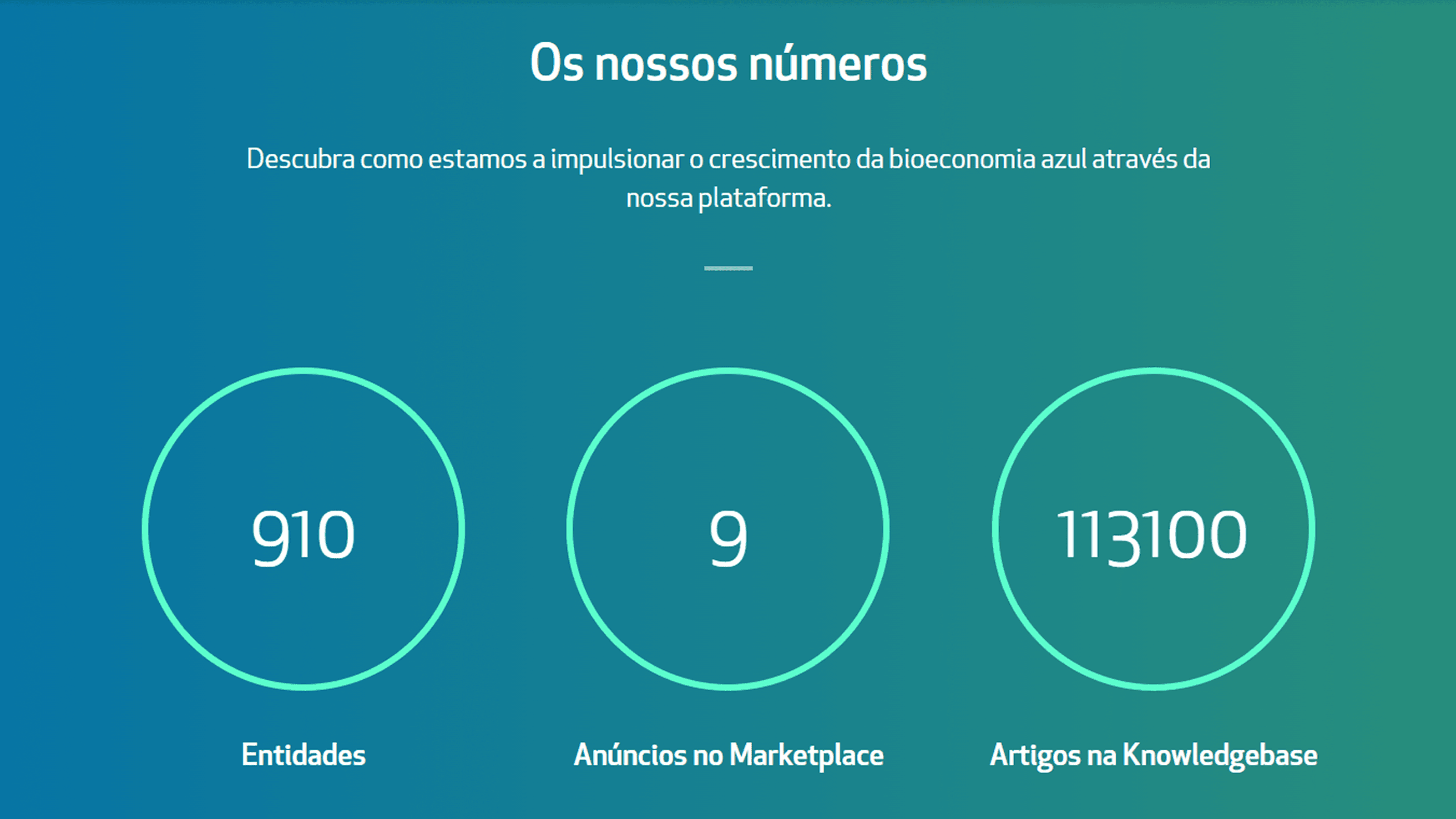
The platform in numbers: 910 entities and 113,100 articles in the knowledge base.
Some notable outcomes of Fish Matter:
By connecting by-product generators with the technologies and partners that can transform them, the platform advances a concrete circular-economy goal: materials once treated as waste become inputs for food, cosmetics, nutraceuticals, biomedicine and chemistry.
Knowledge that was scattered across articles, projects, patents, funding and tenders now lives in one trustworthy hub, giving companies, researchers and public bodies a shared starting point.
Intelligent recommendations and matchmaking surface the right partner or opportunity for each user, shortening the distance between having a by-product and finding its best use.
An AI assistant grounded in the platform's own knowledge base, operated with European data residency, gives users fast, reliable answers while respecting the sensitivity of their data.
Caixa Mágica Software, working with B2E, built for Portugal's blue bioeconomy what the sector did not have: one place where knowledge, supply and demand meet. Fish Matter did more than aggregate information. It added an intelligence layer that proposes connections, and an assistant that answers in natural language without taking the sector's data outside the European Union. It shows how a well-designed platform can advance an environmental goal and an economic one at the same time.

Looking Ahead
A knowledge platform grows more valuable the more the sector uses it. As the community adds projects, technologies and offers, the knowledge base deepens and the recommendation engine learns to make ever sharper connections.
The assistant can be extended to new tasks and content, and the marketplace can broaden across the value chain. Built to evolve, Fish Matter can grow with the blue bioeconomy and the technology that serves it, with B2E steering its future development together with the partners it selects.
Frequently Asked Questions
What is Fish Matter?
Fish Matter is a digital platform for the blue bioeconomy, developed for Blue Bioeconomy CoLAB (B2E). It brings together knowledge, a marketplace and intelligent matchmaking to turn fish and marine by-products, such as heads, viscera, skins and shells, into high-value opportunities for food, cosmetics, nutraceuticals, biomedicine and chemistry.
What data does the Fish Matter platform aggregate?
The platform aggregates sector knowledge from multiple sources: scientific and technical articles, R&D projects, patents, funding lines and open tenders, together with a directory of entities and a legislation database, all in one place. Today it brings together over 100,000 articles, more than 12,000 patents, 160 projects, 433 funding lines and tenders, and 910 entities.
How does the marketplace and matchmaking work?
A marketplace lets organisations offer and find by-products, technologies and services. Alongside it, an intelligent recommendation system using techniques such as collaborative filtering suggests the most relevant partners, opportunities and content to each user, powering matchmaking across the value chain.
Does Fish Matter include an AI assistant?
Yes. The platform includes an AI assistant that answers users' questions using retrieval-augmented generation (RAG) over the platform's own knowledge base, so answers are grounded in the sector content the platform curates. It is operated with EU-based data residency.
More About Fish Matter
Who is Fish Matter for?
It serves the whole blue bioeconomy value chain: fishing and processing companies that generate by-products, transformers and processors, technology and research providers, investors and public bodies working on circular-economy and sustainability goals.
Who developed Fish Matter and how is it funded?
The platform was developed by Caixa Mágica Software for Blue Bioeconomy CoLAB (B2E), based in Leça da Palmeira, within an initiative supported by Portugal's Recovery and Resilience Plan (PRR) through the Blue Bioeconomy mobilising agenda.
Where is the platform's data processed?
Fish Matter is designed with European data residency in mind: its AI services run within the EU, keeping the processing of sector data aligned with European privacy and digital-sovereignty principles.