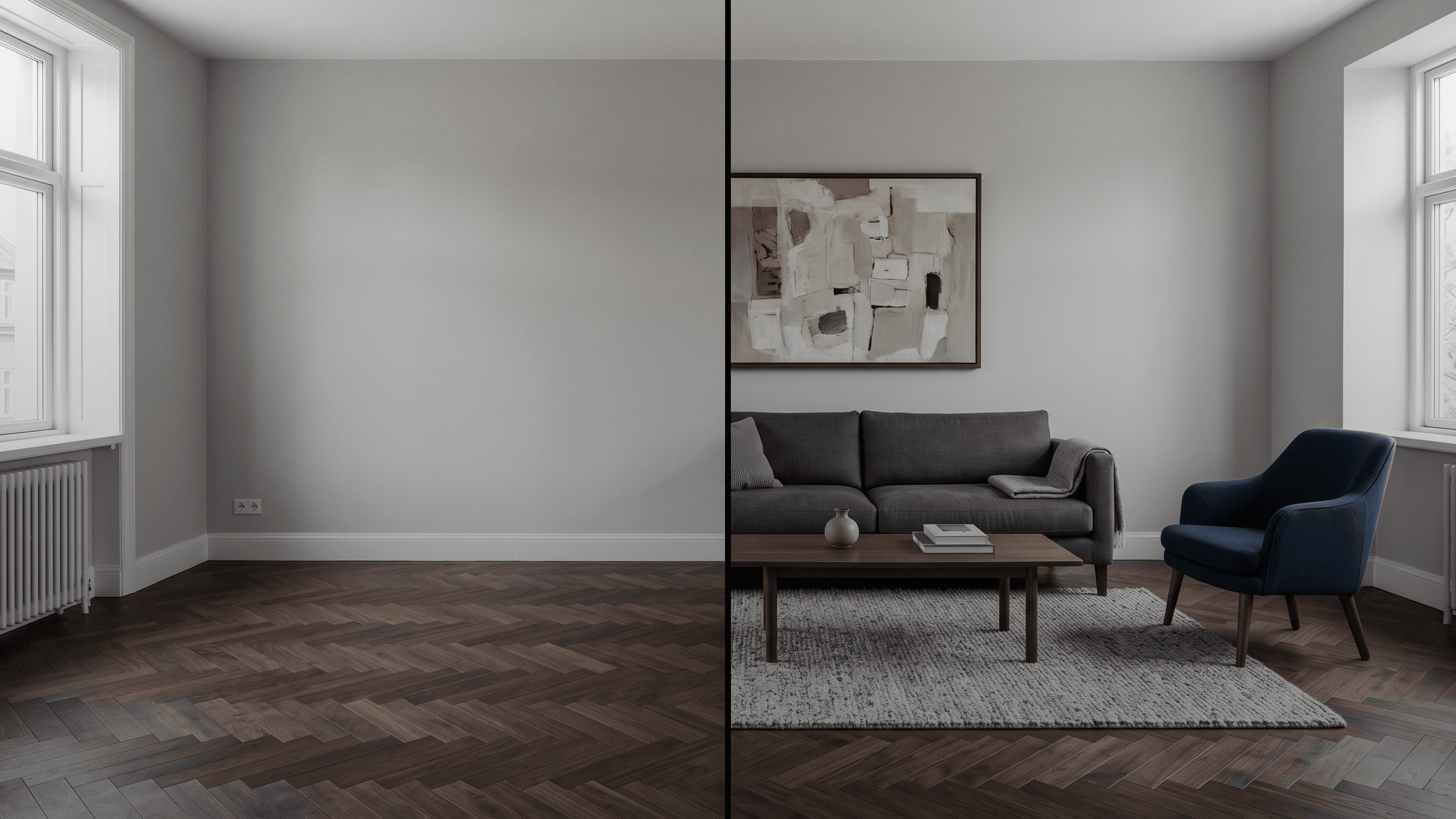
Where Generative AI Visual Marketing Pays Off

Avatar
Author

The useful question about generative AI visual marketing in 2026 is not what the tools can do, since that answer has become impossibly broad. It is where they create durable value rather than a productivity gain that evaporates once every competitor adopts the same tool.

At the Caixa Mágica AI Lab we spend a lot of time on that distinction. The projects that move the needle share a pattern: they apply AI in sectors where the gap between expert-quality output and what the average professional can afford to produce has historically been widest. In those sectors AI does not simply make an existing process faster. It changes the economics of the market.

Real estate visual marketing is the clearest example we have found, and it is the vertical where we built Stageless AI to test the thesis in production rather than in a slide deck.

€500 to €3,000
Physical staging per property, plus furniture logistics and scheduling
Hours per image
Manual virtual staging in Photoshop or SketchUp, by a specialist
€0.60, under 30s
Constrained generative staging at 4K, from a standard photo
From Aug 2026
Labelling duty on the published image under the EU AI Act

The pattern behind valuable generative AI visual marketing

Most tools distribute value evenly across a market. If everyone drafts faster with an AI assistant, the advantage of drafting faster disappears within a couple of quarters. The baseline moves, costs fall for everybody, and the tool becomes infrastructure rather than differentiation.

The more interesting category is where a tool crosses a threshold that previously separated two tiers of a market. That threshold might be cost, time, technical skill or access to specialist equipment. Below it, most operators settle for noticeably lower quality. Above it, a small minority produce output that commands a premium.

When AI crosses that line at a price the broad market can pay, the competitive dynamics change structurally. Professionals who relied on being above the threshold need a new basis for differentiation, while the majority who were below it gain access to quality they could not previously buy. The same pattern shows up in legal document drafting, architectural visualisation, medical imaging pre-processing and photography post-production. In each case the test is identical: can AI close the gap between the quality ceiling and the economic floor, sustainably and at volume?

Why most productivity tools flatten out

Worth naming the uncomfortable implication early, since it applies to our own product. A threshold, once crossed by an accessible tool, stops being a moat for anyone. The agent who adopts virtual staging in 2026 gains an advantage over the agent who does not, although that advantage compresses as adoption spreads. What remains is a permanently higher baseline for buyers and a market where nobody competes on whether the photos are furnished. Durable value accrues to whoever solves the harder version of the problem, not to whoever adopts first.

Real estate: the threshold in concrete terms

Property staging is a well-understood discipline, and surveys from the staging industry consistently report that staged listings sell faster and at higher prices than comparable unstaged ones, with figures often quoted between 5 and 15 percent and days on market roughly halved. Treat the range as directional rather than precise, because most of the underlying data comes from practitioners with an interest in the answer. The direction, however, is not seriously disputed.

Above the threshold
Physically staged
Rented furniture and accessories installed for the shoot, at €500 to €3,000 per property depending on size, market and staging company. It works, and for premium listings the return justifies it easily. Scheduling, transport and access constraints cap how many properties one agency can do per month.
Below the threshold
Photographed empty
Where most listings sit, across Portugal, Spain and Europe generally. Not because agents doubt the value of staging, but because the arithmetic fails on an average listing. An empty room is also genuinely hard for buyers to read, since judging scale from a bare floor is a skill most people do not have.
A well-defined threshold, an expensive crossing and a visible quality difference. That combination is exactly where generative AI produces structural rather than marginal value.

Inside Stageless AI: the constraint problem

Image generation is not the hard part. General-purpose models produce beautiful interiors all day. The hard part is constrained generation: furnishing a specific real room while preserving its exact geometry, proportions, lighting and structural features.

Why constraint matters more than aesthetics
Real photograph in
A standard smartphone shot of an empty room, with its own light and angles
Structure preserved
Wall angles, window positions and proportions stay exactly as photographed
Publishable out
4K in under 30 seconds, at €0.60 on the pay-as-you-go plan
A staged image that invents a window, shifts a wall or scales a sofa wrongly is worse than no staging, because the buyer who visits spots the discrepancy and stops trusting the whole listing.

That requirement drove the dataset and the constraint architecture, and it explains why Midjourney or a general image model is not a substitute here. Their job is to imagine. This job is to reproduce a real place accurately while adding only what was asked. The platform also runs object removal, decluttering and lighting correction, since the same constraint discipline applies to all four. Data is processed inside the EU and property images are handled on a session-only basis rather than stored, which matters more to agency clients than it used to.

Want to see the constrained output rather than read about it? The platform gives you three photos to test with.
Explore Stageless AI

The disclosure duty that comes with generative AI visual marketing

Here is the part most virtual staging vendors leave out. Since 2 August 2026, Article 50(4) of the EU AI Act requires whoever publishes AI-generated or manipulated image content to disclose it. Article 3(60) defines the relevant category broadly, covering content that resembles existing persons, objects, places or events and would falsely appear authentic. A digitally furnished photograph of a real room falls inside that definition, so the obligation lands on the agent or agency publishing the listing.

Label at the point of encounter. The disclosure has to be visible when the person sees the image, in plain language, without needing a tool or an extra click. The Commission has published an EU icon set and Code of Practice for exactly this.
Metadata alone is not enough. Machine-readable marking is the provider's obligation under Article 50(2). A deployer cannot rely on it to satisfy their own duty, because nobody browsing a portal inspects EXIF data.
Terms and conditions do not count. A line buried in site terms fails the test, according to the Commission's guidance on Article 50. So does a vague phrase that avoids saying the image was altered.
Other rules still apply. Consumer protection law, portal policies and national estate agency rules run in parallel. Compliance with the AI Act does not discharge them, and misleading a buyer about a property remains a separate problem entirely.

What a compliant listing looks like

In practice this is undramatic. A caption reading "virtually staged with AI" on each altered image, an unaltered photograph of the same room included in the gallery, and no staged image used where a buyer could mistake furniture for something included in the sale. Agencies that already disclosed virtual staging as good practice have almost nothing to change. Those treating disclosure as optional now have an enforceable obligation, and our summary of what changed in August 2026 covers the wider picture.

The four criteria the AI Lab applies to generative AI visual marketing

Real estate was not chosen arbitrarily. It matched four conditions that we now use as a filter when deciding where to build next.

Criterion 1
Most operators below the line
A large professional market where the majority produce output they know is worse than the standard, held back by cost rather than by preference.
Criterion 2
A well-defined output
Clear quality criteria that a professional can judge in seconds. Ambiguous outputs make it impossible to know whether the model is good enough to ship.
Criterion 3
A real constraint problem
Accuracy to a real-world reference that general-purpose tools do not deliver. Without this, a purpose-built platform has no reason to exist next to a generic model.
Criterion 4
A behaviour-changing price
Cheap enough that the whole market changes what it does, rather than cheap enough that the premium segment saves money.
Going from pattern recognition to a product that delivers the promised economics is the harder half. Constraint architecture, workflows for high-volume users with no technical training, and a quality bar set at publishable rather than impressive are the lessons that carry to the next vertical.

What generative AI visual marketing does not change

Four limits worth stating, because vendors in this category tend not to.

Bad source photography stays bad. Constrained generation preserves what it is given, including poor exposure, awkward angles and a lens that distorts the room. Garbage in produces well-furnished garbage out. Physical staging also keeps its place at the top of the market, where buyers walk through a presented home and the photography is only the invitation. Nor does any of this improve a property, so an agent using staged images to compensate for a listing that disappoints in person is accelerating a rejection rather than a sale. And the advantage is temporary by construction, which follows from the argument above: crossing a threshold cheaply means everyone crosses it. The lasting benefit goes to buyers, who get to see what a space could hold, and to whichever operators build workflow around the tool instead of treating it as a novelty.

Frequently asked questions

Generative AI visual marketing and Stageless AI

What is Stageless AI and who is it built for?
Stageless AI is an AI virtual staging platform built by the Caixa Mágica AI Lab in Lisbon. It turns photographs of empty or cluttered properties into photorealistic staged images at 4K, in under 30 seconds, from €0.60 per image on the pay-as-you-go plan, with monthly plans for higher volumes. It is built for estate agents, property developers and property photographers who need professional presentation at a volume and cost that physical staging cannot reach.
What is the Caixa Mágica AI Lab and what does it build?
The AI Lab builds applied AI products for specific verticals and AI solutions for enterprise clients, including regulated sectors such as financial services, energy and public administration. Stageless AI is the Lab's first standalone product. The selection filter is consistent: a large professional market sitting below a quality threshold, a well-defined output, a constraint problem general tools do not solve, and a price point that changes market behaviour.

Tools and constraints

Why can't Midjourney or a general image model do this?
General-purpose models produce attractive interiors but are not constrained to preserve the geometry, proportions and structural features of a specific real room. They add windows that do not exist, shift wall angles and scale furniture implausibly. For a listing where the buyer will visit the physical space, those inconsistencies disqualify the image. Stageless AI was trained for real estate photography with the constraint that original structural elements are preserved exactly.
Does virtual staging work for cluttered rooms as well as empty ones?
Yes, though it is a different operation. Furnishing an empty room adds objects to a clean space, while a cluttered room usually needs decluttering or object removal first, so the platform runs those as separate modules. Results depend heavily on the source photograph, since no model recovers detail that the camera never captured.

Disclosure and compliance

Do virtually staged property photos need to be labelled?
Yes, in the EU. Article 50(4) of the AI Act requires deployers to disclose AI-generated or manipulated image content, and Article 3(60) defines that to include content resembling existing objects or places that would falsely appear authentic. A digitally furnished photograph of a real room falls within it. The label must be clear and visible when the person encounters the image, so metadata or a line in the site terms does not satisfy the obligation.
Who is responsible for the label, the platform or the agent?

Both, in different ways. The provider of the generative system carries the machine-readable marking obligation under Article 50(2), while the deployer publishing the listing carries the visible disclosure obligation under Article 50(4). An agency cannot rely on the platform's marking to discharge its own duty, and portal rules and consumer protection law apply on top.
Caixa Mágica Software
Caixa Mágica Team
Caixa Mágica Software is a Portuguese software company with 20+ years of experience delivering custom software, AI solutions and nearshore development teams for European businesses.
AI Lab · Caixa Mágica Software
Working on a threshold problem in your own market?
Stageless AI is what this thesis looks like in production. If your sector has a clear quality threshold that AI could cross at scale, our AI Lab works on exactly that kind of problem, from proof of concept to production deployment.